Posts

Showing posts with the label moral philosophy

Aristotle's Nicomachean Ethics: How to live the good or virtuous life. Day 189

Image
So Im continuing with the ethics series, and after I plan on making a series where I qualify the theories and bring up some common objections or problems with them. Today we'll look at Aristotle's Nicomachean Ethics. Here's the wikipedia link: http://en.wikipedia.org/wiki/Nicomachean_Ethics#Synopsis I won't copy and paste the entry this time, simply because there is no quick and dirty section that explains the heart of the philosophy well. I must also remind the reader that this text was written a long time ago, about 2000 years ago, and it was written what was then Greek. So it of course had been translated, and so their will always be translation issues, as with the original bible, for example. Having said that, the text does provide some useful insights into human nature, as well as uses some commonsense points to express how to act/live, which is my opinion/perspective (from here on out I won't express this, since it should be assumed that this blog is my p...
Creating the greatest happiness - A look into Mill's Utilitarianism (day 185)

Image
So I will be continuing with the Moral Philosophy theme that I started yesterday with a post on Kant's Categorical Imperative .  I mentioned Mill's Utilitarianism, which was another topic covered in my introduction to Ethics course in Reed College. Let me say that Mill's writing is much more clearer or easier to read than Kant's writings. I copied and pasted this from wikipedia. http://en.wikipedia.org/wiki/Utilitarianism_%28book%29  ~~~~~ The essay is divided into five chapters, namely General Remarks; What Utilitarianism Is; Of the Ultimate Sanction of the Principle of Utility; Of What Sort of Proof the Principle of Utility is Susceptible; and On the Connection Between Justice and Utility. In the first two chapters, Mill aims to define precisely what utilitarianism claims in terms of the general moral principles that it uses to judge concrete actions, as well as in terms of the sort of evidence that is supposed to be given for such principles....

Are people just means to an End? A look into Kant's Categorical Imperative (day 184)

Image
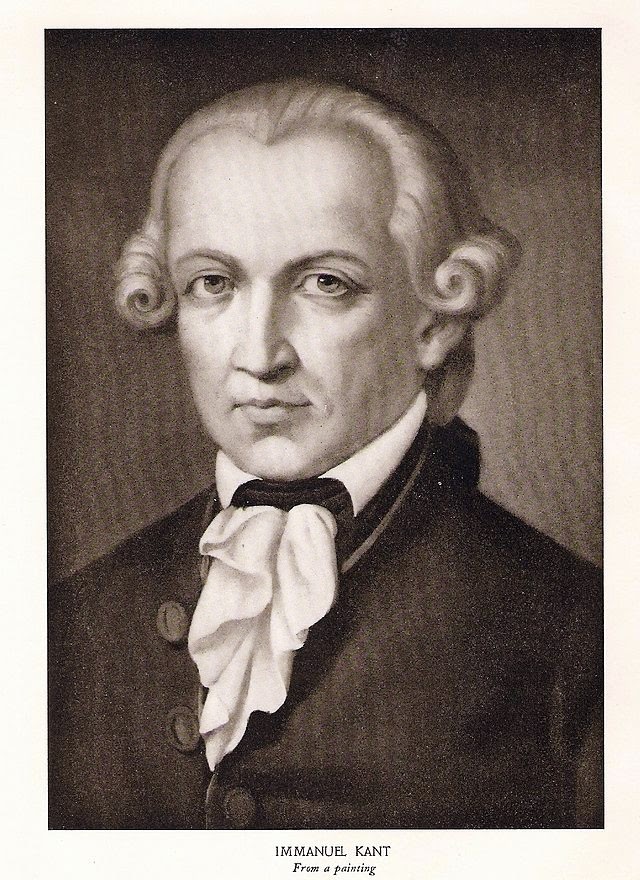
  I attended Reed College. In my freshman year I took the introduction to ethics course. In the course we covered Mill's Utilitarianism, Kant's Categorical Imperative, and Aristotle's Nicomachean ethics. I would like to share what I saw as important for human beings to be aware, which I received from reading the works done by these men. These important things are still relevant today in my life, and how I live. I copied and pasted a section from wikipedia on Kant's Moral Philosophy. I suggest for the reader to read through it, even if you may not understand everything completely, so to at least have an idea. I will then explain how I understood Kant's philosophy in my own words, and by examples.     Section from Wikipedia http://en.wikipedia.org/wiki/Immanuel_Kant#Moral_philosophy Kant is known for his theory that there is a single moral obligation , which he called the " Categorical Imperative ", and is derived from the concept of duty . Ka...